

Average Bathroom Remodel Cost Guide
The average bathroom remodel cost in Central Florida depends on the work included, not just the room's size. As a historical reference, Orlando's project benchmarks were $23,950 for a midrange bathroom remodel and $75,963 for an upscale remodel. These are history, not live quotes. This guide shows how to use those figures to build a realistic budget for Orlando, Winter Park, or Windermere, and to prepare for a bathroom remodeling quote from Aston Stuart.
What is the average bathroom remodel cost in Central Florida?
There is no single average that prices every Central Florida bathroom. Published Orlando benchmarks give useful context, but your bathroom renovation price should reflect the room's condition, the materials you choose, and the exact scope. Treat the average bathroom remodel cost as a starting point for talk, not as a promise.
The figures below describe separate project types in the 2026 Orlando Cost vs. Value data. They are reference points, not current Aston Stuart prices or a true average for Winter Park and Windermere.
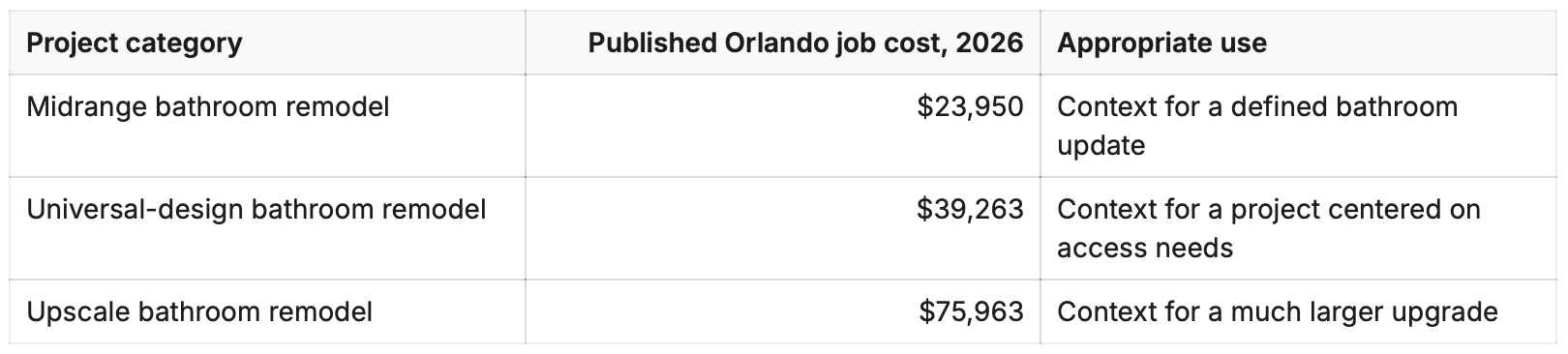
These figures show why the average cost of a bathroom remodel needs detail. Different project specs create very different budgets, even in the same market. Do not treat the lowest and highest figures as the limits of every bathroom project.
For your own plan, decide whether you want to refresh finishes, rebuild the bathing area, or redesign the whole room. Then ask for pricing tied to that scope. That gives the average bathroom remodel cost a useful role without letting it set the wrong budget.
Define the project before choosing a budget
Write a short scope note before you gather inspiration or set a spending cap. Include what stays, what changes, and which problems the remodel must solve. Use the categories below to shape that note.
Cosmetic refresh
Use this category when your goal is mostly appearance. Your wish list might include paint, mirrors, accessories, or selected finish swaps while keeping the existing bathing area and layout. Identify each retained component so the quote does not by mistake include replacement work you never intended.
Also list anything that worries you about the room now. Ask for leaks or moisture problems to be checked rather than hiding them behind new finishes. Moisture-control guidance focuses on correcting water sources during renovation.
Shower or bathing-area remodel
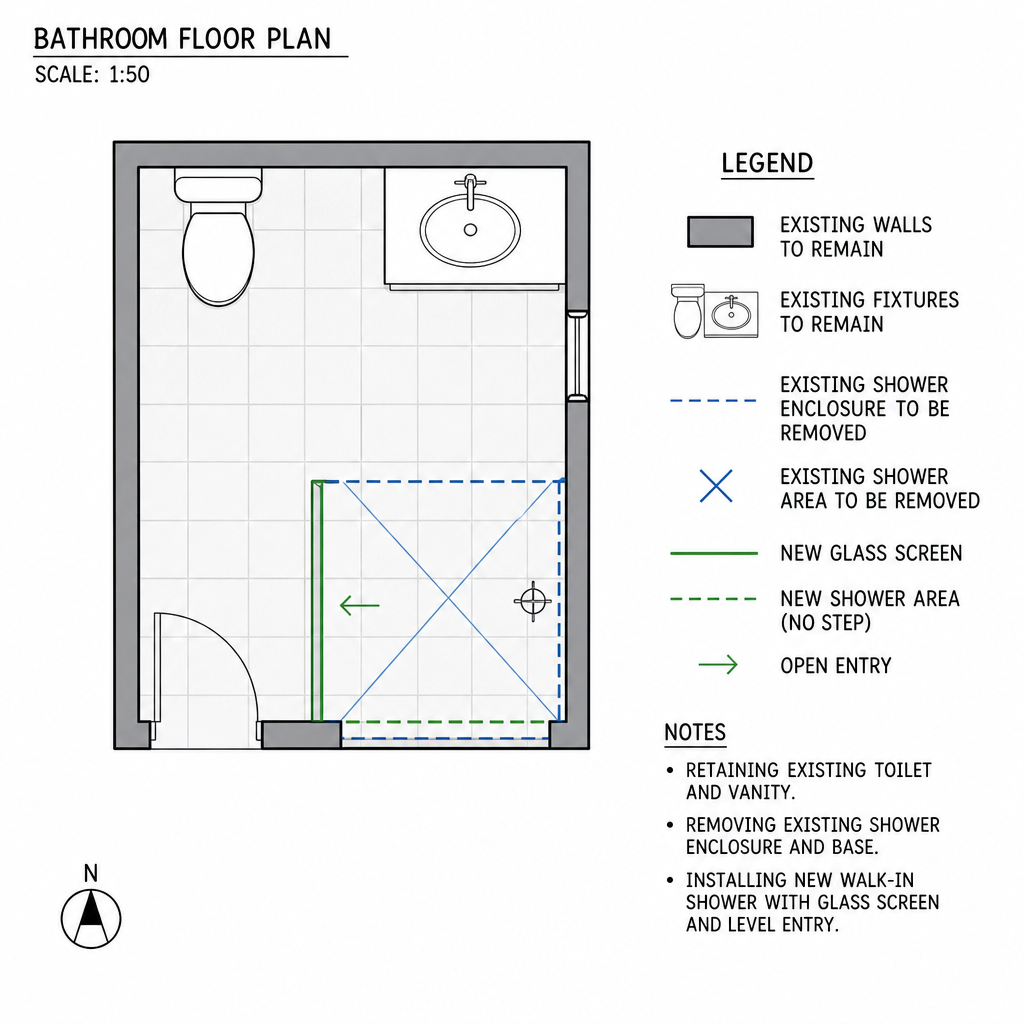
Use this category when the shower or tub is the main focus. Aston Stuart says shower work can include removal, surface prep, shower pans, waterproofing, tile, niches, and benches. Its tub-to-shower conversion guidance also says plumbing moves and extra trade work should be listed separately.
Make that difference clear in your request. Ask whether the quote covers only the bathing area or also flooring, vanity work, painting, and electrical changes elsewhere. A clearly bounded shower project is easier to review than a vague bathroom upgrade.
Whole-room renovation
For a full-room project, make a replacement list for the bathing area, toilet, vanity, flooring, lighting, and wall finishes. Mark layout changes on a simple sketch. Then ask which items need more review before firm pricing is possible.
Do not use complete remodel as the full plan. Attach the list to every pricing talk and ask for exclusions in writing. This gives you a clear definition of completion before construction begins.
Local budgeting in Orlando, Winter Park, and Windermere
Keep the estimate tied to the property itself rather than giving a city name an automatic premium or discount. For each location, prepare the same details: photos, dimensions, desired changes, access notes, and known problems. Then confirm which jurisdiction handles the address before making permit assumptions.
Orlando: establish the construction and trade scope
Orlando's residential permitting guide says most construction needs permits, and related electrical, plumbing, gas, or other work can need trade permits. Its electrical application also notes that rewiring rooms or opening walls requires current-code compliance in the affected areas. Ask which rules apply to your bathroom rather than assuming every renovation follows the same path.
For budgeting, ask for a clear split of the visible improvements and the work behind them. If you want new vanity lighting, for example, say whether you are replacing a fixture or moving it. Give the estimator enough detail to identify the needed trade work.
Winter Park: identify the alteration accurately
Winter Park provides separate application resources for building, electrical, and plumbing work, plus a checklist for minor residential interior alterations. Use those resources to confirm the submission steps for your scope. Do not assume a small room means an easy permit process.
When you discuss a Winter Park bathroom, say whether you are keeping the existing layout or planning a larger change. Ask how discoveries after demolition will be documented and priced. Keep those unknowns separate from optional upgrades so you can make informed choices if the scope changes.
Windermere: verify the address jurisdiction
The Town of Windermere specifically warns that some properties with Windermere mailing addresses lie outside its official limits and fall under Orange County jurisdiction. Confirm the property's city before relying on a permit checklist or fee assumption. A mailing address alone does not show the right building department.
Once the jurisdiction is clear, focus on the room's needs. For a larger primary bathroom, ask for separate descriptions of each bathing area, vanity, enclosure, and finish zone. This helps you review each choice instead of accepting one unexplained total.
Where the remodeling budget goes
Ask for bathroom remodel pricing that separates prep, installation, products, and project management. Use the categories below as a review frame, not as a set percentage split. Your goal is to see what the total really buys.
Removal, protection, and preparation
Request written details for protecting the path through your home, removing existing materials, handling debris, and preparing exposed surfaces. Ask what condition the room must be in before installation starts. Include a question about how unexpected damage will be handled.
Aston Stuart lists shower and tile removal and surface prep as part of its shower installation services. Its bathroom flooring description also focuses on prep, layout, spacing, and finishing. Confirm which of those tasks are included in your quote. (astonstuart.com)
Plumbing, electrical, and ventilation
List each system change on its own: moving a drain, replacing a valve, moving lighting, adding an outlet, or changing the exhaust path. Then ask who is responsible for the work and whether it appears in the quoted total. For permitted projects, confirm the related trade requirements with the local authority.
Do not let fixtures included replace a clear description. Ask whether that phrase covers product supply, installation, connections, and any needed support work. Record the answer with the relevant fixture choice.
Tile, cabinetry, glass, and finishing
Build a selection sheet for tile, vanity, countertop, faucets, toilet, shower enclosure, mirrors, and accessories. For each item, note the product, quantity, supplier responsibility, and installation responsibility. Ask for detail wherever a selection is still open.
For tile, request the intended coverage and layout, not just a product name. For glass, ask whether the enclosure is fully defined or held as an allowance. Finally, confirm who handles painting, trim, hardware, and final cleanup so those tasks do not disappear between scopes.
Protect the moisture-management budget
A bathroom renovation should address water control as well as appearance. Federal remodeling guidance recommends fixing leaks, handling condensation, building wet walls to block water entry, and venting bathroom air directly outdoors rather than into an attic. These are practical items to include in a Florida renovation discussion.
Ask your estimator to explain the plan in plain language. You do not need to design the assembly yourself, but you should know which prep and water-management tasks the quote includes. Keep those answers with your project files.
Use this checklist during the walkthrough:
Existing moisture: point out leaks, stains, soft spots, or damp areas and ask how they will be checked.
Wet-area construction: ask for a description of the shower or tub surround assembly.
Ventilation: ask where the exhaust ends and whether it will be tested.
Discoveries: agree on the approval process if removal shows damaged materials.
Documentation: ask what install details and care instructions you will get.
The goal is not to assume every bathroom has a hidden problem. The proposed renovation should address any existing moisture issues rather than covering them with new finishes. Moisture control guidance consistently focuses on correcting the source of excess water.
How can you build a realistic bathroom remodeling budget?
Build your budget from a defined scope, documented selections, known exclusions, and a reserve for unknowns. Start with the most you can spend, then work backward to see what fits. Keep optional upgrades outside that commitment until you price the essential work.
Separate the contract from the spending ceiling
Use this planning equation:
Total project budget = contracted work + separately purchased items + excluded project expenses + contingency.
For example, suppose your spending cap is $30,000. If you keep $4,000 for uncertainty and $2,000 for items outside the contract, $24,000 remains for contracted work. These are sample budgeting choices—not local market prices or an Aston Stuart estimate.
Choose the reserve after discussing the room's condition and the unresolved scope. Ask which assumptions are firm and which still need proof. Do not use the reserve to justify upgrades before the unknowns are clear.
Give allowances close attention
Ask whether undecided products are listed as allowances and request a written definition of each one. Confirm whether the allowance covers the product only or also tax, delivery, accessories, and installation. Keep a running total against those amounts.
For example, if an illustrative vanity allowance is $1,000 and you pick a $1,600 product, the product difference is $600 before other changes. Ask for the full revised cost before approving the selection. This keeps a small upgrade from becoming an unclear adjustment.
Rank priorities before making cuts
Divide your wish list into three groups: needed repairs and performance items, helpful usability upgrades, and optional design upgrades. Then ask for alternatives within each group. Compare the revised scope, not just the revised total.
If the price is above your ceiling, ask for options that keep more of the existing layout or reduce decorative scope. Ask what each option removes and what it keeps. Make the final choice against your priorities rather than an arbitrary average bathroom remodel cost.
Permits, inspections, and project responsibilities
Permitting should be discussed before you approve the final scope. Orange County says most remodeling, electrical, plumbing, mechanical, and structural work needs a permit and recommends checking first if the rules are unclear. Winter Park also keeps separate permitting and inspection resources for alterations and trade work.
Ask for a written responsibility list covering applications, fees, required documents, inspection scheduling, and permit closeout. Confirm whether those services are included or billed separately. Do not approve a vague permit allowance without knowing what it means.
Also ask whether your scope needs more review before pricing can be final. Keep the answer specific to the address and project. That is more useful than a general claim that bathroom remodels always need permits or never need them.
How should you compare bathroom remodeling quotes?
Compare quotes by matching scope, specs, allowances, exclusions, and responsibilities before you compare totals. A good comparison shows whether each proposal covers the same finished result. If one leaves major choices open, ask for clarity before calling it the cheaper option.
Use this worksheet during your review:
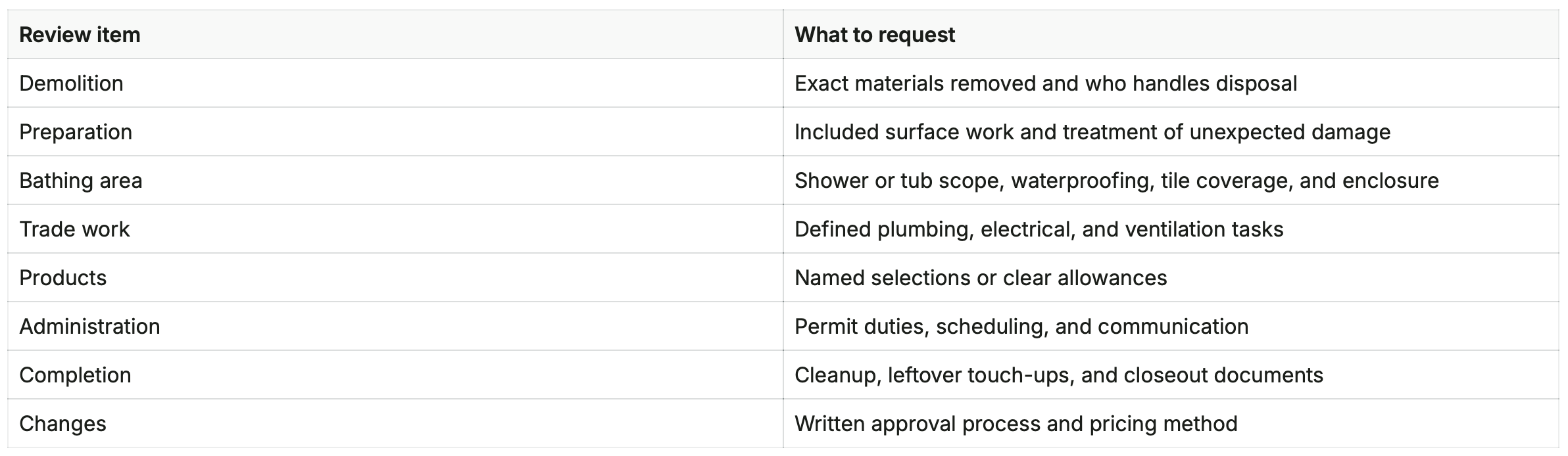
Next, mark every difference between proposals. Ask whether the difference is a planned scope choice, an open selection, or a missed task. Do not assume similar wording means the same work.
Pay close attention to owner-supplied products. Request agreement on who checks dimensions, confirms fit, receives deliveries, handles damage, and resolves missing parts. Put those duties in writing before you place orders.
Finally, ask about the payment schedule and what work or milestone each payment covers. Request written warranty terms for the actual installation and selected products. Keep the signed scope, approved changes, and payment records together through the project.
Keep outside-market averages in perspective
For a Central Florida project, searches such as average bathroom remodel cost Bay Area or average bathroom remodel cost Medford should be treated as outside-market research, not local pricing evidence. The same applies to average cost of a bathroom remodel in Austin area 2024, which also points to a past year. Keep your working budget tied to the actual Florida property.
When you review any cost article, note its location, publication year, project definition, and stated exclusions. Ask whether the figure describes a partial update or a specific whole-room renovation. If those details are missing, do not use the number as your spending commitment.
Use Orlando's historical benchmarks for context, then move to a current, property-specific scope. That keeps bathroom remodel pricing relevant to your choices without pretending an online average can replace an estimate.
Prepare for a useful consultation
Before contacting Aston Stuart, gather a short project brief. Include photos of the whole room, close-ups of concerns, approximate measurements, and a short list of desired changes. Add a few reference images, and label exactly what you like about each one.
Use these prompts to make the conversation useful:
State the main problem. Explain whether the priority is the shower, storage, access, appearance, or a known defect.
Identify what stays. List fixtures and finishes you hope to retain, subject to evaluation.
Describe the desired scope. Separate bathing-area work from whole-room improvements.
Share your total budget. Clarify whether it includes separately purchased products and a reserve.
Explain timing limits. Mention household access needs and any preferred completion window.
Request clear boundaries. Ask which services include and which additional trades require separate coordination.
Aston Stuart lists custom showers, tub-to-shower conversions, bathroom tile, and waterproofing among its services, with coverage across Orlando and Central Florida, including Winter Park and Windermere. Use the consultation to confirm the fit between those services and your complete project scope. (astonstuart.com)
Turn a planning average into a project-specific quote
The most useful bathroom renovation price is one you can trace back to a clear scope. Keep the historical average in the background while you define the work, choose materials, identify responsibilities, and leave room in the budget for unresolved conditions. That process gives you a better base for deciding what to build and what to leave out.
For homeowners in Orlando, Winter Park, and Windermere, the next step is a talk about the actual bathroom, not another unrelated national average. Bring your priorities, photos, and budget questions so the proposed work can be discussed clearly.
Contact Aston Stuart for a free quote for bathroom remodeling. Ask about your plans for the shower, tile, or tub-to-shower conversion. Confirm what is needed to move your Central Florida project forward. (astonstuart.com)